
When a vehicle program or new equipment line launches late, the post-mortem usually points to the shop floor. Tooling arrived behind schedule. A supplier missed PPAP. Fixtures needed rework. Line rate took longer to reach than planned.
Those are real problems. But trace most of them back far enough and you end up in the same place: the handoff between engineering and manufacturing. Drawings arrived incomplete or late. Process plans were built on a design that changed two weeks later. The bill of materials manufacturing received didn't match what engineering released. A supplier quoted from a drawing that was missing a critical callout.
For operations leaders, this is the launch bottleneck nobody budgets for. It doesn't appear as a line item, yet it drives a large share of launch cost, delay, and early-production scrap.
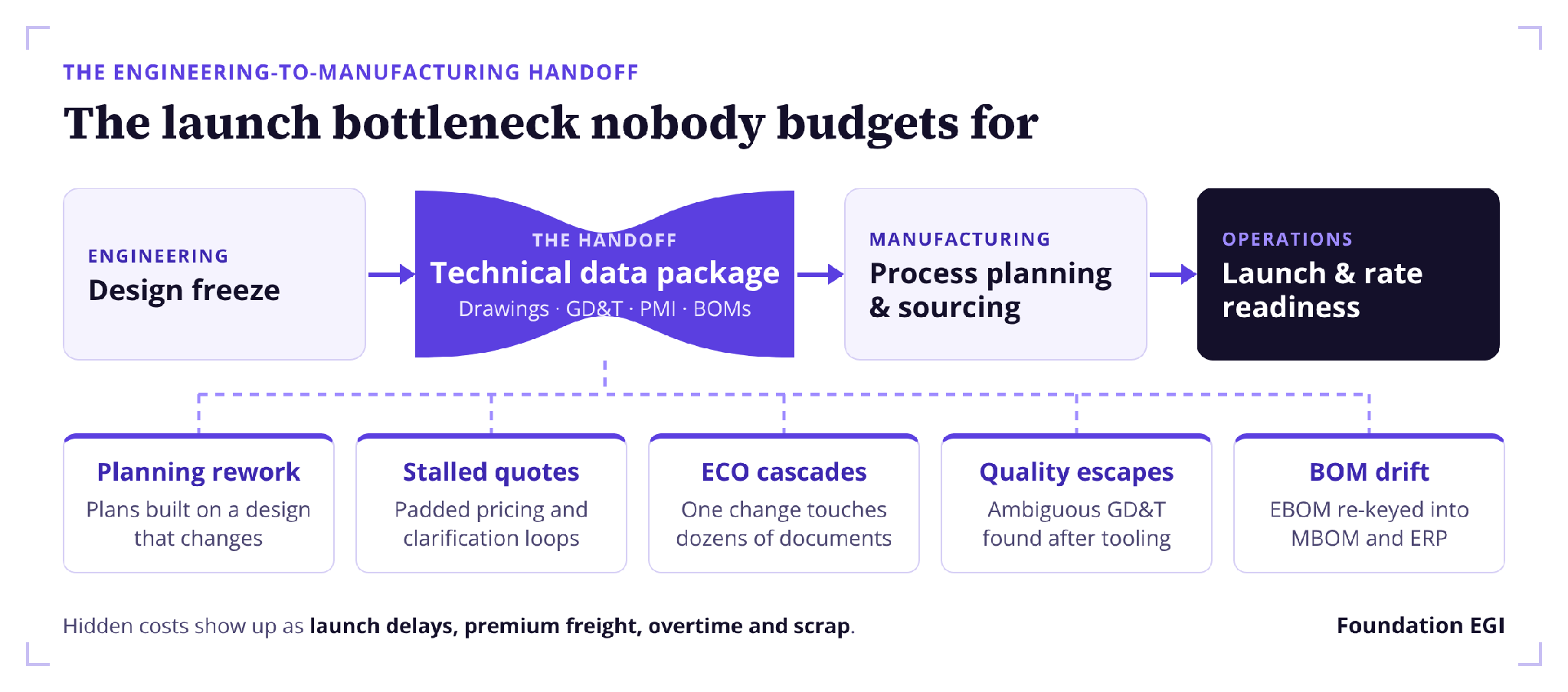
The hidden cost of an incomplete technical data package
Manufacturing can only plan, quote, tool, and inspect from what engineering hands over. When that package is late, inconsistent, or incomplete, the cost shows up across operations, usually without a clear owner:
- Process planning starts late or starts twice. Manufacturing engineers wait for released drawings, or begin on preliminary data and redo the work when the design changes.
- Supplier quotes and sourcing decisions stall. Fabricators, machine shops, and stampers can't quote accurately without complete drawings, tolerances, and material specs. Missing information turns into padded quotes, clarification loops, or surprises at first article.
- Engineering changes cascade. A single ECO can touch drawings, routings, work instructions, fixtures, gauges, and supplier documents. Each manual update is another chance for a mismatch.
- Quality issues surface in production. Ambiguous GD&T or a datum scheme that doesn't reflect how the part is fixtured leads to inspection disputes, deviations, and scrap, often after tooling is committed.
- BOMs are rebuilt by hand. Engineering BOMs are re-keyed into manufacturing BOMs and ERP, creating the version drift that plagues early production.
None of these show up on a dashboard as "documentation cost." They appear as launch delays, premium freight, overtime, and quality escapes. They are symptoms of the same upstream constraint.
Why the pressure is rising
Several forces are converging to make this handoff harder, not easier.
More programs, more variants, less time. Automotive OEMs and suppliers are running ICE, hybrid, and EV programs at once. Construction, agricultural, and industrial equipment makers handle growing configure-to-order complexity, where nearly every order can carry unique content. Each variant needs its own documentation and process plans.
Resourcing is in motion. Tariffs, reshoring, and dual-sourcing strategies mean parts are moving between suppliers and plants faster than ever. Every move requires a clean, complete technical data package. Many organizations find their legacy drawings aren't good enough to hand to a new supplier without significant cleanup.
The experienced workforce is shrinking. The engineers and planners who could fill gaps in incomplete documentation through experience are retiring. Deloitte and The Manufacturing Institute project 2.3 million technician openings through 2030, driven largely by retirements and exits.
AI ambitions depend on clean data. According to Deloitte's 2026 outlook, 92% of manufacturers see smart manufacturing as the main driver of competitiveness, and 80% plan to put at least 20% of improvement budgets into it. But AI for scheduling, quality, or process optimization is only as good as the product and process data underneath it. Inconsistent engineering data limits every initiative built on top of it.
This is an operations problem, not just an engineering one
It's tempting to treat drawings, GD&T, and BOMs as engineering's business. They sit in engineering's tools, owned by engineering's headcount, measured by engineering's release dates.
But operations pays the bill. Manufacturing carries the cost of every late release, every ambiguous callout, and every BOM mismatch. That cost shows up in throughput, launch timing, supplier performance, and scrap.
The most effective operations leaders are reframing the engineering-to-manufacturing handoff as a value stream they co-own. They ask the same questions they would ask about any production constraint:
- How long does it take from design freeze to a complete, manufacturing-ready data package?
- How often does process planning start before that package is stable, and what does the rework cost?
- How many ECOs per program reach manufacturing, and how many documents does each one touch?
- How many supplier quotes or first articles are delayed by missing or unclear drawing information?
Once the handoff is measured like a production process, it becomes clear that it can be improved like one. That includes applying automation where the work is repetitive and rules-based.
What operations leaders can do now
- Put the handoff on the launch scorecard. Track time from design freeze to a manufacturing-ready package alongside tooling, PPAP, and rate readiness. What gets measured gets resourced.
- Target the high-volume part families first. Sheet metal, weldments, machined, injection molded and stamped components make up much of the documentation load at most OEMs, Tier 1s, and equipment makers. They are also the most rule-based, which makes them the best place to start with automation.
- Treat your legacy drawing base as an asset to modernize. If resourcing or reshoring is on your roadmap, the quality of your technical data packages will set how fast you can move. Cleaning up and standardizing them is supply-chain resilience work.
- Insist on AI that understands manufacturing. General-purpose AI tools can draft emails and summarize reports. They can't reason about fixturing, weld access, or whether a tolerance is holdable on a turned part. Look for domain-specific solutions built on engineering and manufacturing knowledge.
- Connect the chain end to end. The biggest gains come when drawings, PMI, and BOMs flow directly into process planning, routings, and work instructions without re-keying.
Closing the gap
Operations leaders have spent decades taking waste out of the factory: lean, automation, digital twins, MES. The next big constraint isn't on the shop floor. It sits upstream, in the documentation and data that tell the shop floor what to build.
Companies that compress the engineering-to-manufacturing handoff will launch faster, resource with less risk, and get more out of every AI investment they make downstream.
At Foundation EGI, we build domain-specific AI solutions for engineering and manufacturing. EGI Design turns 3D CAD and engineering intent into drawings, GD&T, PMI and DFM checks, validated against ASME/ISO and your own standards, so manufacturability issues surface at the point of design instead of on the shop floor. Paired with EGI Process Planning, that same design intent flows directly into MBOMs, assembly sequences and work instructions, giving manufacturing a complete, consistent data package sooner. If launch readiness or resourcing is on your agenda, reach out to us at info@foundationegi.com.
Sources: Deloitte 2026 Manufacturing Industry Outlook · Deloitte and The Manufacturing Institute on technician openings